Hot-mix asphalt is almost never a do-it-yourself purchase. It leaves the plant at around 300 °F, has to be spread and rolled before it cools, and is normally bought installed from a paving contractor. The reason to work out the quantity yourself is to read a quote: paving is priced by the ton, and the tonnage tells you whether the thickness you were promised is the thickness you are paying for.
From area to tons
Asphalt is weighed, so the calculation runs through volume to weight:
Tons = area × thickness in ÷ 12 × density ÷ 2,000
Compacted hot mix weighs roughly 145 lb per cubic foot, which is about 1.96 tons per cubic yard. That is the density the asphalt calculator assumes; mixes vary a little, and the plant’s ticket is the real weight.
Worked example: a 30 × 20 ft driveway, 600 square feet, paved 2½ inches thick.
- 600 × 2.5 ÷ 12 = 125 cubic feet
- × 145 lb = 18,125 lb, or 9.06 tons
- Add 5% for irregular edges and low spots: 9.52 tons
- Plants ticket in half-ton or whole-ton steps: a 10 ton order
Another way to hold the same figure: at 2½ inches, one ton covers about 66 square feet.
Thickness is the number to check
Thickness multiplies straight through, so a small change is a large one in tons. The same 600 square feet:
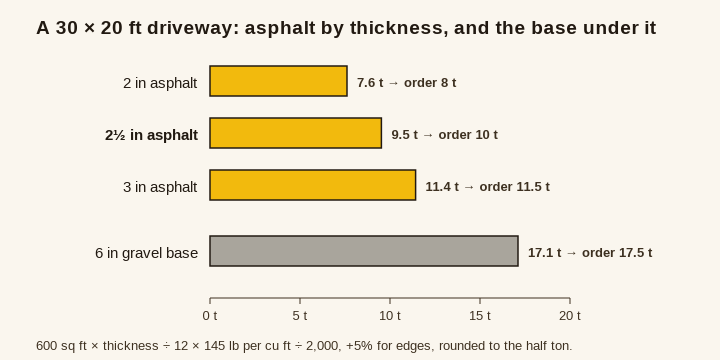
| Finished thickness | Order |
|---|---|
| 2 in | 8 tons |
| 2½ in | 10 tons |
| 3 in | 11½ tons |
Residential driveways are commonly 2 to 3 inches compacted; paths can be 2, and a drive that takes trucks often goes to 4 or more, sometimes in two lifts. The figure in a quote should be the compacted thickness. Asphalt is laid loose and rolled down by roughly a quarter, so a crew can spread 3 inches and finish at a little over 2. If a quote gives a tonnage, divide it back by the area to see which thickness it actually buys.
The base matters more than the asphalt
A new driveway sits on compacted crushed stone. The asphalt is a wearing surface; the base carries the load and drains water away. A thin layer of asphalt on a good base outlasts a thick layer on soft soil.
Six inches of base under the example driveway is 12.2 cubic yards with 10% for compaction, about 17.5 tons of gravel: nearly twice the weight of the asphalt. On clay or in a freeze-thaw climate, paving contractors often go deeper. The base is calculated the same way as any gravel order, and the asphalt calculator lists it under the asphalt.
Overlays and resurfacing
An overlay is new asphalt over an existing, sound surface. It is thinner, often 1½ to 2 inches, and needs no new base. Two things are different:
- Tack coat. A thin spray of asphalt emulsion bonds the new layer to the old. Rates are small, about 0.06 gallons per square yard as sprayed, so the example driveway takes about 4 gallons. Without it the overlay can slide and delaminate.
- Condition of the old surface. An overlay copies the cracks underneath within a few seasons unless they are repaired first. Alligator cracking or soft spots mean the base has failed, and new asphalt on top will fail the same way.
At 1½ inches the example driveway is a 6 ton overlay.
Patching
Small holes are filled with bagged cold patch, which is bought by the bag and compacted with a tamper or a car tire. It is a repair, not a surface; it stays softer than hot mix. The calculator can convert a small area into bags for exactly this.
Reading a paving quote
- Ask for the compacted thickness and the tonnage, and check one against the other with the formula above.
- Ask what base is included, at what depth, and whether existing material is being removed or paved over.
- Plants have minimum loads. A small path may be quoted as a full minimum, which is why small jobs cost more per square foot.
- Edges, drainage and the transition to the street or garage slab are where driveways fail first. They are labour, not tonnage, and belong in the quote.
The density and allowances here are planning figures. The plant’s weight ticket and the contractor’s specification govern the actual job.