Every project starts with the right number.
Pick a tool off the wall, give it your measurements, and walk out with a buy list in gallons, boxes, cubic yards or wire gauge, with waste margin and code tables already figured in.
A calculator hands you a quantity. It can't tell you whether you measured the right surface, whether the coverage it assumed matches your can, or when a pour is big enough to call a truck. The guides cover that part, with worked examples and diagrams you can check against your own project.
-
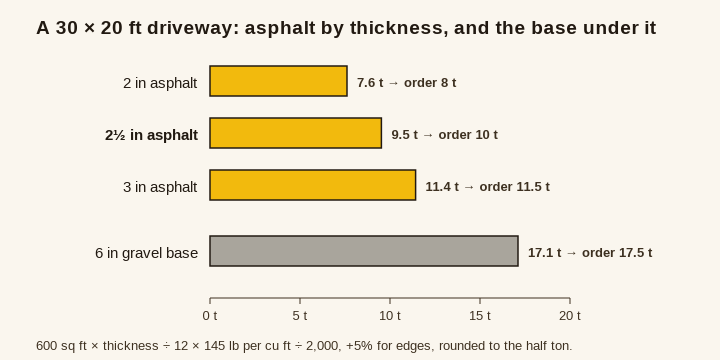 Asphalt driveways: tons, thickness and base
Asphalt is sold by weight. How area and thickness become tons, and why the gravel base usually outweighs the asphalt.
-
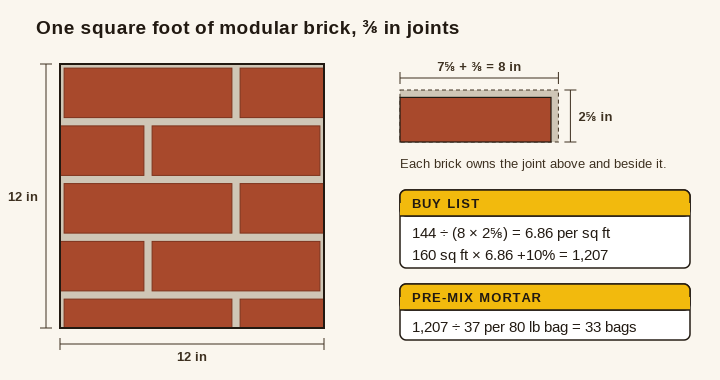 Brick and block: counting units and mortar
Units per square foot come from the face plus the joint. Mortar follows the unit count, not the area.
-
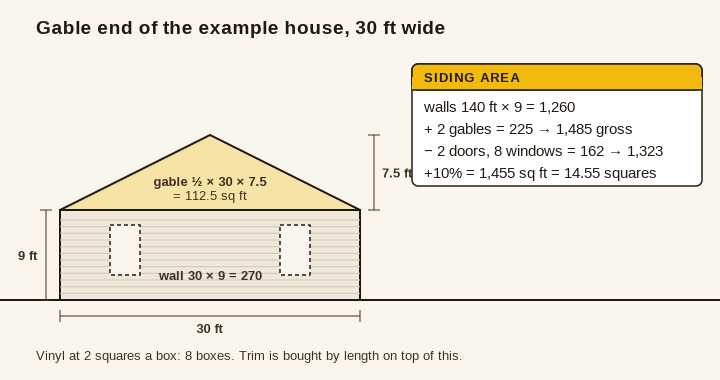 Siding: walls, gables, squares and trim
Rectangles for the walls, triangles for the gables, then the trim that is bought by the foot.
Square Footage
Add up any space, then shop
Answer in sq ftPaint
Gallons and quarts for any room
Answer in gallonsWallpaper
Rolls with pattern waste
Answer in rollsFlooring
Boxes with waste built in
Answer in boxesDrywall
Sheets, screws, mud and tape
Answer in sheetsTile
Boxes, thinset and grout
Answer in boxesInsulation
Batts or blown-in, by the bag
Answer in bagsWall Framing
Studs, plates and headers
Answer in studsBoard Foot
Lumber volume, waste and price
Answer in board feetMulch & Soil
Cubic yards and bag counts
Answer in yardsTopsoil
Lawns, beds and raised-bed fill
Answer in yardsGravel
Yards and tons delivered right
Answer in tonsSand
Tons, yards and bags by the job
Answer in tonsAsphalt
Tons of hot mix, plus the base
Answer in tonsPaver Patio
Pavers, base, sand and edging
Answer in paversSod & Seed
Rolls, pallets or pounds of seed
Answer in rollsConcrete
Bags, yards, slabs and footings
Answer in bagsFence
Posts, rails, and picket runs
Answer in postsDeck Boards
Boards, screws, linear feet
Answer in boardsStairs
Risers, treads and stringers
Answer in stringersBrick & Block
Bricks, blocks, mortar and sand
Answer in bricksRoofing
Squares, bundles and the trim
Answer in bundlesSiding
Wall squares, boxes and trim
Answer in squaresRafters
Length, stock and count by pitch
Answer in raftersWire Size
AWG for the load and the run
Answer in AWGVoltage Drop
What a long run costs you
Answer in % dropConduit Fill
Trade size for the wires you pull
Answer in trade sizeService Load
100, 150 or 200 amp service
Answer in ampsGenerator
Running watts plus the surge
Answer in wattsRecessed Lighting
How many cans, and how far apart
Answer in fixturesWatts & Amps
The power triangle, solved
Answer in wattsMeasure. Hang. Buy.
Most calculators stop at an area ("you need 180 square feet"), which isn't what the shelf sells. Every PlankMath tool converts your room into purchase units: coats and coverage into gallons, square footage plus waste into sealed boxes, depth into cubic yards and bag counts, amps and distance into a wire gauge. The assumptions are printed on the tag, where you can change them.
- Output comes in the units stores actually sell.
- Coats, waste %, coverage rates and code tables are yours to adjust.
- The number lands as you type, and the how-it-works text sits below it.
- Copy the buy list, or copy a link that holds your numbers.
One project, several tools
A bathroom is drywall, then paint, then flooring, then a circuit for the fan: four numbers over three weekends, and by the time the third matters nobody remembers the second. A free account keeps them together in a named project, so the buy list you worked out in March is still there in May.