Concrete is the one material on a DIY list where the quantity decides the method as well as the price. A dozen bags is an afternoon with a wheelbarrow. Sixty bags is two and a half tons of material, mixed and placed by hand, and the first batch is setting before the last one is mixed. The arithmetic is simple. Knowing which side of that line your pour lands on is the useful part.
Volume first
Every concrete estimate starts as a volume, and the only unit trap is thickness, which is measured in inches while everything else is in feet.
Cubic feet = length ft × width ft × (thickness in ÷ 12)
Cubic yards = cubic feet ÷ 27
Then add a waste allowance. Ten percent is the usual figure, and it is not really waste. Subgrade is never perfectly flat, forms bow slightly, excavations come out a little deep, and some concrete stays in the mixer and the wheelbarrow. Running short in the middle of a pour leaves a cold joint, a weak seam where fresh concrete meets concrete that has already started to set. A spare bag costs a few dollars. A cold joint in a slab is permanent.
Worked example: a 10 × 10 ft pad, 4 inches thick.
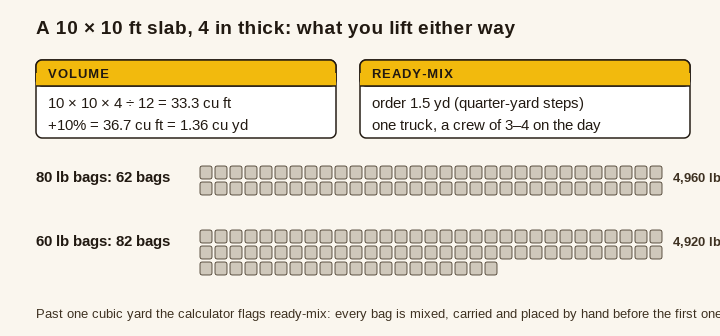
- 10 × 10 × (4 ÷ 12) = 33.3 cubic feet
- Add 10%: 36.7 cubic feet
- ÷ 27 = 1.36 cubic yards
Turning volume into bags
Bagged concrete is sold by weight and yields by volume. The yields printed on the bags are close to these:
| Bag | Yield |
|---|---|
| 40 lb | 0.30 cu ft |
| 50 lb | 0.375 cu ft |
| 60 lb | 0.45 cu ft |
| 80 lb | 0.60 cu ft |
Divide the cubic feet by the yield and round up. The example pad is 36.7 ÷ 0.6 = 62 bags of 80 lb, or 36.7 ÷ 0.45 = 82 bags of 60 lb. The concrete calculator does this for each bag size and shows the cubic feet beside the count, so you can check it against the label on the pallet you are buying from.
The 80 lb bag is cheaper per cubic foot and means fewer bags to open. The 60 lb bag is easier to lift and pour cleanly into a mixer. Pick on your back, not on the price difference.
Where the line is
The calculator flags ready-mix once a pour reaches one cubic yard. That is a planning threshold, not a rule, and it moves with your crew and your mixer. The things that set it:
- Working time. Concrete gives you roughly an hour or two of workability in mild weather and less in heat. Every bag has to be mixed, carried, placed and consolidated inside that window, along with the screeding and floating.
- Weight. Sixty-two 80 lb bags is about 4,960 lb. You load it at the store, unload it at home, carry it to the mixer, and then move it again as wet concrete, which is heavier still once the water is in.
- Consistency. Hand-mixed batches vary in water content. In a small pad that is invisible. In a slab it shows as patchy colour and uneven strength.
A short-load ready-mix order usually carries a minimum charge or a short-load fee, so a truck for half a yard is poor value. Somewhere between one and two yards, most people find the truck cheaper once they count a mixer rental, two trips with a trailer, and a second pair of hands for the whole day.
Ready-mix is ordered in fractions of a yard; many suppliers take quarter-yard steps, some only half yards. Round your total up to their step, not down. The example pad is a 1.5 yard order.
Footings and post holes
Round pours use the area of a circle instead of a rectangle:
Cubic feet per hole = π × (diameter in ÷ 24)² × depth ft
Six deck footings, 10 inches across and 3 feet deep, come to 10.8 cubic feet with 10% added, which is 18 bags of 80 lb. Set a 4×4 post in each hole first and the post displaces about 1.7 cubic feet across the six holes, allowance included, which brings it to 16 bags. The calculator subtracts the post when you tell it there is one.
Holes are where hand-mixing makes the most sense. Each one is a separate small pour, there is no surface to finish, and a cold joint between two holes does not exist.
Things the volume does not include
- Gravel base. Most slabs sit on 4 inches of compacted gravel. That is a separate order, by the ton, and it has to be compacted before the forms are set. The gravel calculator handles it.
- Reinforcement. Rebar or welded wire mesh controls cracking. The concrete calculator lists rebar sticks and mesh sheets as optional lines, but the spacing and bar size are a design decision for the job.
- Thickened edges. A slab that carries a wall or a vehicle often has a thicker perimeter. Calculate that strip as its own pour and add it.
- Thickness variation. A slab specified at 4 inches with a subgrade that dips to 5 in places uses noticeably more. Ten percent covers ordinary variation, not a poorly graded base.
A short checklist
- Measure length, width and the real thickness, including any thickened edge.
- Work out cubic feet, add 10%, convert to cubic yards.
- Under about a yard: count bags, and plan the mixing so placement is continuous.
- Over a yard: call two ready-mix suppliers, ask their minimum, their step size and their short-load fee, and book the pour for a cool morning.
- Have the base compacted, the forms braced and the finishing tools out before the first bag is opened or the truck arrives.
The calculator’s figures are planning estimates from geometry and published bag yields. They do not replace a design for a structural slab or a footing that carries a building load; that is a question for your local building department.