Conduit fill answers a narrow question: will these conductors physically fit in this conduit with enough room to pull them without damaging the insulation, and to let heat escape. The answer is an area calculation against a percentage. It does not answer whether those conductors can carry their full current once they share the pipe, which is a second check people often miss.
The limits
The NEC limits the share of a conduit’s internal area that conductors may occupy (Chapter 9, Table 1):
| Conductors | Maximum fill |
|---|---|
| 1 | 53% |
| 2 | 31% |
| 3 or more | 40% |
Two conductors get the lowest limit because two round wires in a pipe can jam against each other across the diameter during a pull. Most real circuits have three or more, so 40% is the working number.
Add up the areas
Each conductor’s area comes from its size and insulation type (Chapter 9, Table 5). THHN/THWN-2, the common building wire, is about 0.0133 square inches at 12 AWG, 0.0211 at 10 AWG and 0.0507 at 6 AWG. Conduit internal areas come from Chapter 9, Table 4, and differ by type: ½ inch EMT has about 0.304 square inches inside.
Fill % = total conductor area ÷ conduit internal area
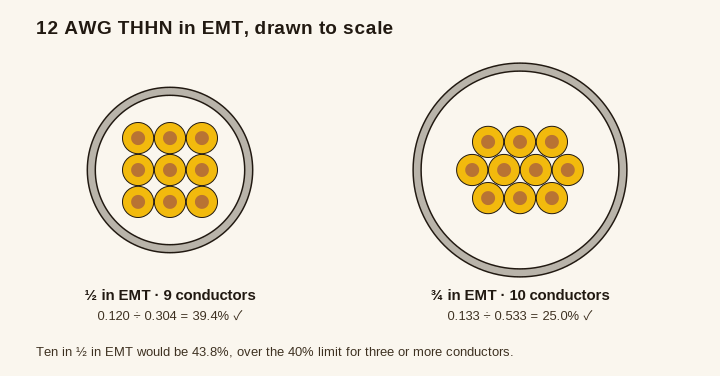
Worked example: nine 12 AWG THHN conductors in ½ inch EMT.
- 9 × 0.0133 = 0.120 square inches
- 0.120 ÷ 0.304 = 39.4%, just under the 40% limit
A tenth conductor makes it 0.133, which is 43.8% of ½ inch EMT. The next size up, ¾ inch EMT at 0.533 square inches, takes ten at 25%.
The equipment ground counts toward fill. A feeder of three 6 AWG conductors and a 10 AWG ground is 0.173 square inches, which fits ¾ inch EMT at 32%. The conduit fill calculator takes a mix of sizes and picks the smallest trade size that passes for EMT, PVC or rigid conduit.
The second check: derating
Conductors that share a raceway heat each other. When more than three current-carrying conductors are in one conduit, their ampacity is reduced (NEC Table 310.15(C)(1)):
| Current-carrying conductors | Ampacity |
|---|---|
| 4 to 6 | 80% |
| 7 to 9 | 70% |
| 10 to 20 | 50% |
The nine 12 AWG conductors from the example fit, but if all nine carry current, their ampacity drops to 70%. Starting from the 90 °C column of 30 amps, that leaves 21 amps, still enough for 20 amp circuits, but only because THHN’s 90 °C rating gives the margin. Neutrals that carry only unbalanced current and equipment grounds do not count as current-carrying; whether a neutral counts depends on the circuit.
Fill and derating are independent. A conduit can pass the fill check and still force larger wire because of derating, which is why packing many circuits into one pipe is often a false economy.
Things that change the answer
- Nipples. A conduit section 24 inches or shorter between boxes may fill to 60%.
- Bends and pull length. The fill limit assumes a reasonable pull. Long runs and many bends make pulling at the limit hard; the code limits a run to 360 degrees of bends between pull points, and electricians often size up for difficult pulls.
- Other insulation types. XHHW, USE and others have different areas. Use the table row for the wire actually installed.
- Cables in conduit. NM cable in a sleeve or multiconductor cable in conduit is calculated with the cable’s overall dimensions, not the individual conductors.
The figures here come from the NEC tables the calculator cites, simplified for planning. Local adoption and amendments vary, electrical work generally needs a permit, and a licensed electrician or the inspector decides what complies.
These are simplified planning methods. The implementation does not record a verified NEC edition and has not been independently reviewed by a licensed electrician. See electrical sources and limits before relying on an estimate.