A generator has to do two things: keep everything you plug in running, and survive the moment a motor starts. Motors, like those in a refrigerator compressor, a furnace blower or a well pump, draw two to three times their running power for a second or two as they start. A generator sized only on running watts stalls or trips at that moment, usually when the refrigerator cycles on in the middle of the night.
Running watts first
List what you need during an outage and add up the running watts from each appliance’s nameplate, or from a typical figure when the label is not handy. A modest essentials list:
| Load | Running | Starting |
|---|---|---|
| Refrigerator / freezer | 700 W | 2,200 W |
| Furnace blower, ½ hp | 800 W | 2,350 W |
| 10 LED lights | 100 W | 100 W |
| TV, router, phone charging | 250 W | 250 W |
| Total | 1,850 W |
These are typical values; actual appliances vary widely, and the label wins.
Then the largest surge, once
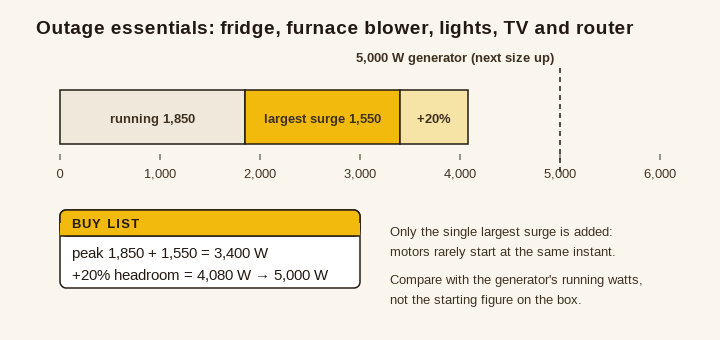
The starting surge is the extra power above running for the moment a motor starts. For the furnace blower that is 2,350 − 800 = 1,550 watts; for the refrigerator, 1,500. Only the largest surge is added, because motors rarely start at exactly the same instant:
Peak = total running + largest single surge
1,850 + 1,550 = 3,400 watts.
Headroom and the shelf
Generators run hotter, louder and shorter-lived near their rated limit, and their real output drops at altitude and in heat. A common margin is 20% above the peak: 3,400 × 1.2 = 4,080 watts. Generators come in fixed sizes, so the generator sizing calculator rounds up to the next common size: a 5,000 watt unit.
Check that the figure you compare against is the generator’s running (rated) output. The large number on the box is usually its starting or peak output.
How fast it grows
Adding loads changes the answer more than people expect, because a new motor can also become the largest surge:
- Add a ⅓ hp sump pump and a 10,000 BTU window air conditioner: running 3,850 W, the air conditioner’s 2,400 W surge becomes the largest, peak 6,250 W, and with headroom it is a 7,500 W generator.
- Add a sump pump and a ½ hp well pump instead: running 3,650 W, peak 5,200 W, a 6,500 W generator.
Electric water heaters, ranges and central air conditioners are the loads that push a portable generator past practical. Each is several thousand watts on its own. Running them is a standby-generator conversation.
Connecting it safely
The sizing is the easy part. The connection is the safety-critical part.
- Never backfeed a house through a dryer outlet or a “suicide cord”. It can energise the utility line outside and kill a line worker, and it bypasses every protection in the panel.
- Use a transfer switch or an interlock kit installed at the panel, which makes it impossible for the generator and the utility to be connected at the same time. This is generally permit work.
- Or run extension cords rated for the load directly to appliances, which is safe and limits you to what is plugged in.
- Carbon monoxide. Run a portable generator outdoors, well away from windows, doors and vents, never in a garage, even with the door open. Fit CO alarms inside.
For how a whole-house load is counted and what a panel can take, see does my panel have room for it. Nameplate data governs over the typical figures here, and a licensed electrician should install the transfer equipment.
These are simplified planning methods. The implementation does not record a verified NEC edition and has not been independently reviewed by a licensed electrician. See electrical sources and limits before relying on an estimate.