Insulation is the one material on a home project where you cannot estimate from geometry alone. A bag of blown-in fibreglass covers 170 square feet or 32 square feet depending on how thick you spread it, and the thickness is set by the R-value you are aiming for. So the estimate runs in a fixed order: target R-value first, then the coverage at that R-value, then the bag count.
What R-value measures
R-value is resistance to heat flow. Higher is better, and it adds in layers: two R-19 batts stacked make roughly R-38. It is rated at a specific installed thickness, which matters most for loose fill, because blown insulation settles after it is installed and the R-value applies to the settled depth.
Choose the target
The recommended levels depend on your climate zone and on where the insulation goes. ENERGY STAR publishes a table based on the 2021 International Energy Conservation Code. For an uninsulated attic it runs from R-30 in the warmest zone to R-60 from zone 4 north, with R-49 in zones 2 and 3. Floors over unheated spaces and walls have lower targets.
Your local building code is what an inspector checks, and it can differ from the ENERGY STAR recommendation. The insulation calculator shows the recommended line for the zone you pick.
Batts: coverage is printed on the bag
Batts and rolls come in fixed thicknesses for each R-value and in widths that match the framing: 15 inch for studs or joists 16 inches on centre, 23 inch for 24. Each bag states the square footage it holds. Thicker batts mean fewer to the bag, so a bag of R-38 covers much less area than a bag of R-13 that is about the same size on the shelf.
Bags = area × layers × (1 + waste) ÷ square feet per bag
A 1,000 square foot attic floor, R-38 batts at an assumed 43 square feet per bag, with 5% waste: 1,050 ÷ 43 = 25 bags. R-60 is often two layers of R-30, the second laid across the joists to cover them; that doubles the coverage needed.
Blown-in: coverage comes from a chart
Loose fill has no fixed coverage. The bag carries a chart listing, for each R-value, the square feet one bag covers, the installed thickness and the minimum settled thickness.
For the same 1,000 square feet at R-38, using one published fibreglass chart at 52.6 square feet per bag: 1,050 ÷ 52.6 = 20 bags. At an assumed R-2.8 per inch settled, R-38 is 13.6 inches deep. Cellulose is denser and has a higher R per inch, so it is shallower for the same R-value but takes more, smaller bags.
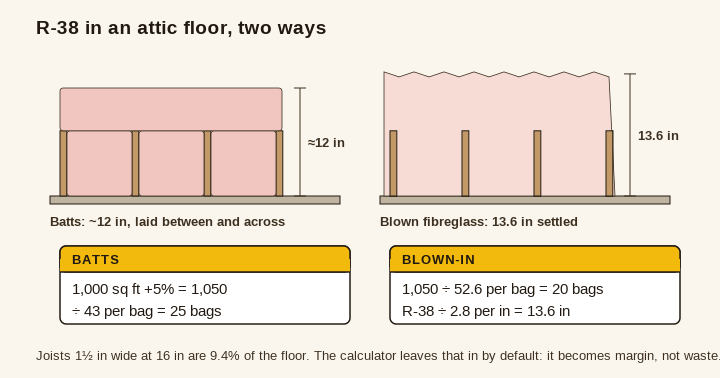
Install blown insulation to the chart’s installed depth, which is higher than the settled depth. Depth rulers stapled to the joists, every few hundred square feet, make it easy to see whether you reached it.
The framing question
Studs and joists take up part of the area. A 1½ inch joist every 16 inches is 9.4% of the floor; at 24 inches it is 6.25%. Insulation does not go where the wood is.
The calculator leaves the framing in by default. The batt coverage printed on most bags is already the framed area, and treating the wood as margin is a safer mistake than running short with the hatch open. You can tell it to deduct the framing if your bag’s coverage is for cavity area.
Before the first bag goes in
The bag count is the easy part. The steps that decide whether the insulation works:
- Air sealing. Gaps around light fixtures, top plates, plumbing stacks and the attic hatch leak warm air straight past the insulation. Seal them first; afterward they are buried.
- Vent baffles. In a vented attic, baffles at the eaves keep insulation from blocking the airflow from the soffit vents.
- Clearances. Recessed lights not rated for insulation contact, chimneys and flues need clearance or a barrier. Follow the fixture and appliance instructions.
- Vapour retarder. Whether one is needed, and on which side, depends on climate zone and the assembly. It is not a universal yes.
Renting the blower
Many home centres lend a blower free with a minimum bag purchase. It needs two people: one feeding the hopper, one in the attic with the hose. Plan the attic route before starting, work from the far end back toward the hatch, and keep the depth rulers in sight.
Coverage figures on this site are assumed typical values from published charts. The chart on the bag you actually buy governs, and the calculator has a field for it.