A lawn estimate has two halves. The grass itself, as sod or seed, is the visible decision. The soil preparation under it, topsoil, a top-dress and starter fertilizer, decides whether that grass is still alive in August. Both halves start from the same number: the area.
Measure the area, not the yard
Measure only the part that will be grass. Subtract beds, the patio, the driveway and the footprint of the shed. Irregular lawns split into rectangles and triangles the same way a room does; see how to measure a room for the method. A 50 × 40 ft back lawn is 2,000 square feet.
Sod: rolls, pallets and a short clock
Sod is sold by the roll and by the pallet, and both sizes are regional. A common roll is about 2 × 5 feet, 10 square feet. Pallets commonly hold 400 to 500 square feet; the sod calculator assumes 450 and lets you change both figures to whatever the farm quotes.
Add waste for cuts. A plain rectangle needs about 5%. Curved beds, trees and narrow strips need 10% or more, because every curve leaves an offcut too small to use.
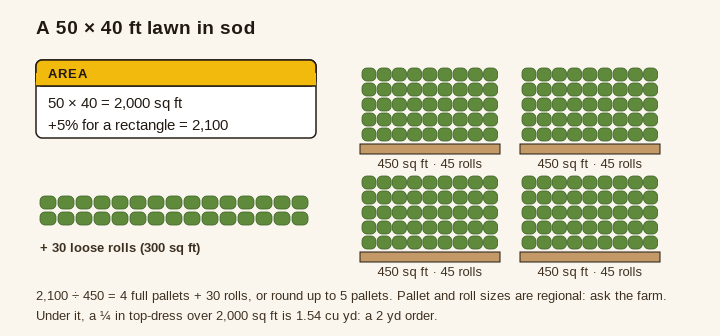
For 2,000 square feet with 5%:
- 2,000 × 1.05 = 2,100 square feet
- 2,100 ÷ 450 = 4.67 pallets: 4 full pallets, with 300 square feet left
- 300 ÷ 10 = 30 loose rolls, or round up to a fifth pallet
Whether to buy the fifth pallet or loose rolls depends on the farm’s pricing. Loose rolls often cost more per square foot than the same area on a pallet, and the pallet itself may carry a deposit.
Sod is perishable. Rolled sod heats up in the stack, and in summer a pallet can start to yellow within a day. Have the soil graded, raked and watered before delivery, and lay it the day it arrives. That timing, more than the price, is the main argument against ordering a large lawn in one delivery.
Seed: a rate, not a coverage
Seed is estimated from a rate in pounds per 1,000 square feet, and the rate depends on the grass and on whether you are starting bare soil or thickening an existing lawn. Overseeding uses roughly half the new-lawn rate.
Pounds = area ÷ 1,000 × rate
Fine fescues and Kentucky bluegrass have tiny seeds and low rates; tall fescue and perennial ryegrass have larger seeds and higher rates. The seed label states the rate for that mix, and it is the figure to use. Divide pounds by bag size and round up.
Seed is far cheaper than sod and more forgiving of timing, but it needs constant moisture for two to three weeks and a season to fill in. It also has a calendar. Cool-season grasses establish best in late summer and early fall; warm-season grasses in late spring and early summer.
Choosing between them
| Sod | Seed | |
|---|---|---|
| Cost | Several times higher | Low |
| Usable | A few weeks | A full season |
| Timing | Most of the growing season, if watered | Narrow windows by grass type |
| Slopes | Holds immediately | Washes out without erosion cover |
| Labour | Heavy, all at once | Light, spread over weeks of watering |
Sod buys time and erosion control. Seed buys choice of grass and a lower bill. On a slope, under trees, or where kids and dogs need the yard next month, sod usually wins. For a large, flat area with time to spare, seed is hard to argue with.
The soil under either one
New grass needs about 4 to 6 inches of loose, decent soil to root into. Where the existing soil is compacted subsoil, which is common after construction, a layer of screened topsoil makes the difference.
Topsoil is volume, the same arithmetic as mulch:
Cubic yards = area × depth in ÷ 12 ÷ 27
Four inches over 2,000 square feet is 24.7 cubic yards, which is several truckloads and a serious amount of spreading. Most lawns do not need that much new material; loosening and amending what is there is often enough. A soil test before ordering tells you which.
Two smaller lines finish the list:
- Top-dress. A thin layer of compost or screened soil raked over seed, or over the soil before sod. A quarter inch over 2,000 square feet is 1.54 cubic yards, a 2 yard order.
- Starter fertilizer. Bags are rated by the area they cover, often around 5,000 square feet. One bag covers the example lawn.
The topsoil calculator works the volume for beds and lawns, and the sod calculator adds the top-dress and fertilizer lines beside the sod or seed.
Water is the real cost
Neither sod nor seed fails for lack of material. Both fail for lack of water in the first three weeks. New sod wants the soil underneath damp every day until the roots take, which you can check by lifting a corner. Seed wants the surface kept moist, which can mean light watering two or three times a day in warm weather. Plan the hoses and sprinklers before the delivery is booked.
The quantities here are planning figures. Roll and pallet sizes, seeding rates and fertilizer coverage are set by the product you buy, and the label wins.