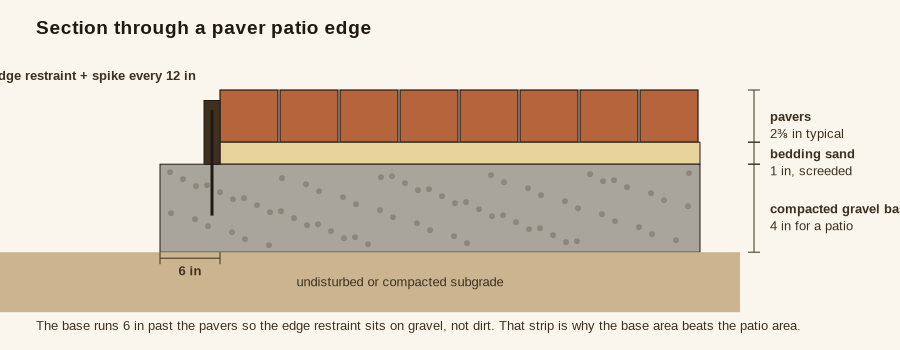
The pavers are the part of a patio you see, and they are usually the smallest order by weight. Under them sit a compacted gravel base and a thin bed of sand, and around them runs an edge restraint that holds the whole field in place. Each is bought in a different unit from a different part of the yard. Skip one and the patio settles, spreads or heaves within a couple of winters.
Layer one: the pavers
Pavers are counted by the piece and sold by the piece, the pallet or the square foot. Count them from the face size:
Pavers = patio area × (1 + waste) ÷ (length in × width in ÷ 144)
A 16 × 12 ft patio is 192 square feet. A 4 × 8 inch brick paver covers 32 square inches, or 0.222 square feet. With 5% for cuts, 192 × 1.05 ÷ 0.222 = 908 pavers.
The face size already allows for the joint. Pavers are made with small spacer lugs on the sides, so the nominal size is the size on the ground.
Waste depends on the edge more than the pattern. A rectangle laid in a running bond cuts only along two sides; 5% is enough. A curved edge, a circle feature, or a herringbone laid at 45 degrees cuts at every edge; use 10%, and order the extras from the same pallet run so the colour matches.
Layer two: the gravel base
This is the structural layer. It spreads the load, drains water away from the sand, and stops frost from lifting individual pavers. Typical depths:
| Use | Compacted base |
|---|---|
| Patio or walk | 4 in |
| Patio on clay or in a cold climate | 6 in |
| Driveway | 8 in or more |
The base extends past the paver edge, usually 6 inches, so that the edge restraint sits on gravel instead of loose soil. That strip is why the base area is larger than the patio. For the 16 × 12 ft example, the paved perimeter is 56 feet, and a 6 inch extension on every side adds 29 square feet, for 221 square feet of base.
Base cubic yards = base area × depth in ÷ 12 ÷ 27
At 4 inches that is 2.73 cubic yards. Crushed stone base weighs about 1.4 tons per cubic yard loose, so it is 3.8 tons. Landscape yards sell in half-ton or half-yard steps: a 4 ton order.
Compact it in lifts of 2 to 3 inches with a plate compactor, wetting the gravel lightly. A full 4 inches dumped and compacted once stays soft in the middle.
Layer three: bedding sand
The pavers sit on about an inch of coarse concrete sand, screeded flat between two pipes. The sand is not structural. It gives each paver a level seat and fills the small irregularities in the base, which is why the layer must stay thin: thick sand shifts.
For the example, one inch under 192 square feet is 0.59 cubic yards, about 0.8 tons. Round up to a half yard step and you have a 1 yard order, or 32 bags of half a cubic foot each. For a patio this size the bulk scoop is less carrying; for a small walk, bags are fine.
Sand goes under the paved area only, not under the extended base strip.
The edge and the joints
- Edge restraint. Plastic or aluminium edging, pinned with 10 inch spikes about every 12 inches. For the example, 56 feet of edge is ten 6 ft pieces and 56 spikes. Concrete curbs and soldier courses set in mortar do the same job.
- Joint sand. After the pavers are laid and compacted, polymeric sand is swept into the joints and wetted, where it hardens enough to resist washout and weeds. Coverage depends heavily on joint width and paver depth. The calculator assumes 60 square feet per 50 lb bag, which is 4 bags for the example; wide joints or tumbled pavers can halve that coverage, so check the chart on the bag.
The whole list
For the 16 × 12 ft patio in 4 × 8 pavers, with the paver patio calculator defaults:
| Line | Quantity |
|---|---|
| Pavers | 908 |
| Gravel base, 4 in | 4 tons (2.73 cu yd exact) |
| Bedding sand, 1 in | 1 cu yd, or 32 half-cubic-foot bags |
| Polymeric joint sand | 4 bags |
| Edging | 10 pieces, 56 spikes |
Add a layer of non-woven geotextile under the base on soft clay; it keeps the gravel from pushing down into the soil. And add the rental: a plate compactor for the base, and ideally for the pavers after laying, with a pad that will not chip them.
What the estimate leaves to you
- Excavation depth. Base, sand and paver thickness add up to about 7½ inches for a 4 inch base, plus any height you want above grade. That much soil comes out and has to go somewhere.
- Slope. Patios need a fall away from the house, commonly about 1/8 to 1/4 inch per foot. That is set in the base, not the sand.
- Local practice. In freeze-thaw climates, landscape suppliers often recommend a deeper base than the table above. Ask the yard that sells you the gravel; they know their local soil.
The figures here use assumed typical densities and coverages. The weight ticket at the yard and the bag label are the numbers to trust.