The tile itself is the easy line on a tile job’s buy list: area plus waste, divided by what a box covers. The materials that hold it in place are where estimates go wrong, because none of them follow the tile count. Thinset depends on the trowel, grout depends on the joints, and backer board depends on the subfloor or wall.
The tile
Tiles = area × (1 + waste) ÷ tile face area
Waste depends on the layout: about 10% for a straight or brick pattern, 15% on the diagonal, 20% for herringbone. Waste allowance, explained covers why. Count the tile on its face alone; the joint is too small to change the count much and ignoring it keeps you on the safe side.
A 10 × 8 ft bathroom floor is 80 square feet. In 12 × 24 inch tile, 2 square feet each, with 10% waste: 88 ÷ 2 = 44 tiles, which is 6 boxes of 8.
Buy from one production lot and keep the spare box. Lots can differ in shade and very slightly in size, and a cracked tile in three years is far easier to replace from the closet than from the store.
Thinset follows the trowel
Thinset coverage per bag is not a fixed number. It depends on how much mortar goes down, and that is set by the notch of the trowel, which is set by the size of the tile. Larger tiles need a bigger notch to get full contact across the whole back.
| Tile, longest side | Typical notch | 50 lb bag covers |
|---|---|---|
| Up to 8 in | ¼ × ¼ in | about 85–95 sq ft |
| Up to 16 in | ¼ × ⅜ in | about 60–67 sq ft |
| Larger | ½ × ½ in | about 42–47 sq ft |
These are commonly published ranges; the bag’s chart governs. Thinset is figured on the area you tile, not the area plus waste, since cut-off waste is never set. The example floor in 12 × 24 tile at a ½ inch notch is 80 ÷ 45, so 2 bags.
Large-format tile often needs back-buttering, a thin skim on the back of each tile as well, which uses more mortar than the chart suggests. If you plan to back-butter, buy an extra bag.
Grout follows the joints
Grout fills the joints, so the amount depends on how much joint there is, how wide, and how deep. Each tile owns half of its perimeter of joint, which gives a tidy formula for joint length per square foot:
Joint inches per sq ft = 144 × (W + L) ÷ (W × L)
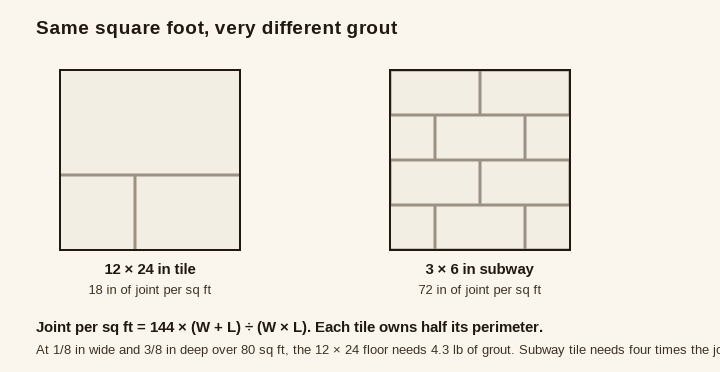
For a 12 × 24 tile, that is 18 inches of joint per square foot. For a 3 × 6 subway tile it is 72, four times as much. Multiply by joint width and depth (the tile’s thickness) to get cubic inches, divide by 1,728 for cubic feet, and multiply by the density of the dry grout, around 110 lb per cubic foot.
The 80 square foot floor in 12 × 24 tile with ⅛ inch joints, ⅜ inch deep, needs about 4.3 lb of grout. In subway tile with 1/16 inch joints, ¼ inch deep, it needs about 5.7 lb despite the narrower joint. A 25 lb bag covers either; the difference matters on a whole shower or a large floor. Most grout makers publish a calculator or a chart, and the tile calculator uses the same joint-volume method so you can compare.
Backer board and the rest
- Cement backer board goes over a wood subfloor or wall studs in wet areas. It comes in 3 × 5 ft sheets (15 square feet), among other sizes. Add waste for cuts around the toilet flange and doorway; the calculator assumes 10%.
- Backer screws and alkali-resistant mesh tape go with the board. Seams get taped and skimmed with thinset.
- Waterproofing in showers is a separate system, a liquid membrane or a sheet membrane, bought by its own coverage.
- Sealer is needed for many cement grouts and natural stone, and not for most porcelain with epoxy or high-performance grout. Check both labels.
- Spacers, leveling clips and a margin trowel are small purchases that decide how flat and even the floor ends up.
The example list
For 80 square feet of 12 × 24 inch porcelain on a floor:
| Line | Quantity |
|---|---|
| Tile | 6 boxes of 8 (44 tiles) |
| Thinset, ½ in notch | 2 bags of 50 lb |
| Grout, ⅛ in joint | 1 bag of 25 lb |
| Spacers or leveling clips | 1 pack |
Coverage and density figures here are typical published values, not a manufacturer’s specification. The thinset and grout bags state the coverage for that product, and the tile maker states the trowel and mortar it wants.