Most electrical questions around the house come down to one relationship between three numbers. An appliance label gives you one or two of them; the circuit breaker gives you another. Putting them together tells you whether something will trip a breaker, which circuit it belongs on, and what it costs to run.
The relationship
Watts = volts × amps
For household circuits in the US, volts is about 120 for ordinary outlets and 240 for large appliances. So:
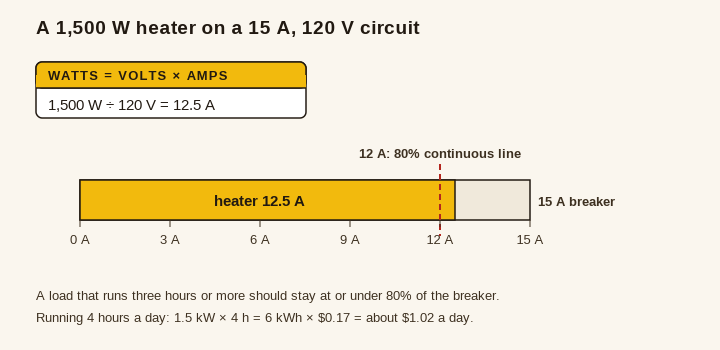
- A 1,500 watt space heater at 120 volts draws 1,500 ÷ 120 = 12.5 amps.
- A 4,500 watt water heater element at 240 volts draws 18.75 amps.
- A 60 watt-equivalent LED bulb using 9 watts draws 0.075 amps.
The watts and amps calculator solves for whichever of the three is missing.
The 80% line
A breaker’s rating is the current it carries indefinitely in a test lab. For a load that runs for three hours or more, a continuous load, the code sizes the circuit at 125% of the load, which is the same as saying the load should stay at or under 80% of the breaker:
| Breaker | Continuous load limit |
|---|---|
| 15 A | 12 A, about 1,440 W at 120 V |
| 20 A | 16 A, about 1,920 W at 120 V |
| 30 A at 240 V | 24 A, about 5,760 W |
The common 1,500 watt space heater draws 12.5 amps, over the 12 amp line on a 15 amp circuit, before anything else on the circuit is counted. That is why a heater on a bedroom circuit that also runs a lamp and a computer can trip the breaker, and why a heater that runs all evening is better on a 20 amp circuit. A 15 amp breaker will usually carry 12.5 amps for some time; the 80% line is about the margin for heat building in the wiring, receptacle and breaker over hours.
Power factor
For heaters, kettles, toasters and incandescent lamps, watts = volts × amps exactly. These are resistive loads.
Motors, compressors and some electronic power supplies draw current slightly out of step with the voltage. Their real power in watts is lower than volts × amps, by a ratio called the power factor:
Watts = volts × amps × power factor
A motor with a power factor of 0.8 drawing 10 amps at 120 volts uses 960 watts, not 1,200, but the wiring still carries the full 10 amps. For sizing a circuit, the amps are what matter. Appliance nameplates usually list amps directly for exactly this reason.
What it costs to run
Utilities bill kilowatt-hours: kilowatts × hours.
Cost = watts ÷ 1,000 × hours × price per kWh
The heater at 1,500 watts for 4 hours a day is 6 kWh. At about 17 cents per kWh, roughly the US residential average, that is about $1.02 a day, or around $31 a month if it runs every day. Many heaters cycle on and off under a thermostat, so the real figure is often lower; a plug-in power meter shows the actual use.
Using the numbers
- Will it trip? Add up the amps of everything that runs at the same time on that circuit and compare with the breaker, and with 80% of it for anything that runs for hours.
- Which circuit? Heavy loads like heaters, window air conditioners and microwaves belong on circuits that do not carry much else.
- New circuits. Wire size follows the breaker and the distance; see wire size, breakers and voltage drop.
Nameplate figures are the reference. The 80% rule is the planning version of the NEC’s continuous-load requirement; the inspector and a licensed electrician decide what a given installation needs.
These are simplified planning methods. The implementation does not record a verified NEC edition and has not been independently reviewed by a licensed electrician. See electrical sources and limits before relying on an estimate.