Masonry is counted by the unit and laid by the square foot. The step between the two is the one people skip: every brick or block occupies its own face plus a share of the mortar joint around it. Count the face alone and the order runs long by about a tenth.
Units per square foot
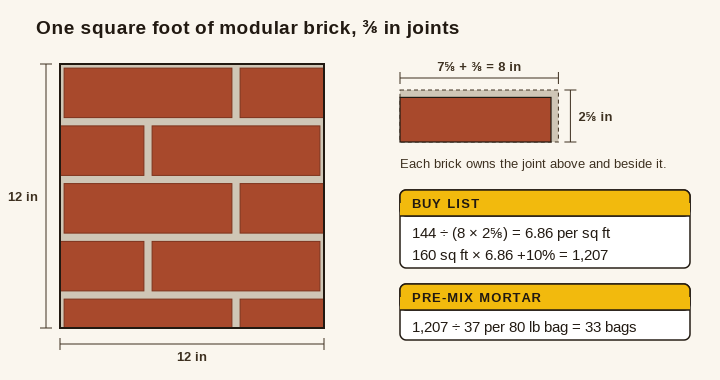
A unit’s nominal footprint is its face plus one joint on one side and one on the top, because each joint is shared between neighbours.
Units per sq ft = 144 ÷ ((length + joint) × (height + joint))
A modular brick has a face of 7⅝ × 2¼ inches. With a ⅜ inch joint it occupies 8 × 2⅝ inches, so a square foot holds 144 ÷ 21 = 6.86 bricks. That is why modular brick is 7⅝ inches long: brick plus joint lands on an 8 inch module, the same module a block is built on.
| Unit | Face | Per sq ft at ⅜ in joint |
|---|---|---|
| Modular brick | 7⅝ × 2¼ in | 6.86 |
| Standard 8 × 8 × 16 block | 15⅝ × 7⅝ in | 1.125 |
A wider joint means fewer units: modular brick at ½ inch joints is 6.45 per square foot. Use the joint you will actually lay.
The wall
Worked example: a 20 × 8 ft single-wythe brick wall, 160 square feet, no openings.
- 160 × 6.86 = 1,097 bricks
- Add 10% for breakage and cuts: 1,207 bricks
Brick is often sold by the cube, a strapped pallet of about 500, so 1,207 is just over two cubes and a few loose. Waste runs 10% for brick, 5% for block, and 15% when the wall has many openings, corners or a pattern.
Subtract openings by their area before multiplying. A double-wythe wall, two bricks thick, doubles both the units and the mortar.
Mortar follows the units
Mortar coverage is published per unit rather than per square foot, because it is the joints around each unit that consume it. Two ways to buy it:
- Pre-mixed mortar in 80 lb bags, just add water. A commonly published yield is about 37 bricks or 13 blocks per bag. The example wall is 1,207 ÷ 37 = 33 bags.
- Masonry cement plus sand, mixed on site at about one part cement to three parts sand. A 70 lb bag of masonry cement with its sand lays roughly 144 bricks, so the wall takes 9 bags of cement and about 27 cubic feet of sand, 1.35 tons, which a landscape yard sells as a 1.5 ton order.
The brick and block calculator works out both. For anything past a small project, cement and sand is far cheaper and far less carrying; pre-mix wins on consistency and on small jobs where a half-used ton of sand is a nuisance.
Bagged yields are “up to” figures. Mortar dropped off the board, joints struck deeper than planned, and mortar mixed and left to stiffen all eat into them. The calculator figures mortar on the units including waste, which leaves a margin.
A block wall
The same method with a different unit: a 20 × 4 ft block wall is 80 square feet, 1.125 blocks per square foot, 90 blocks, and 95 with 5%. At 13 blocks to a bag of pre-mix it takes 8 bags.
Block walls usually also need things the count leaves out: bond beams, rebar and grout in the cores, which depend on the wall’s job and are set by a design, not by a calculator.
What the count is not
- Not a structural design. Retaining walls, walls that carry a load, and tall freestanding walls need footings, reinforcement and often an engineer.
- Not the accessories. Brick veneer needs wall ties to the structure, flashing and weep holes at the base and over openings, and lintels across openings. The calculator can add ties at a commonly cited spacing; the rest is counted from the drawings.
- Not the footing. A garden wall still needs a concrete footing below the frost line or on a compacted base. The concrete guide covers that volume.
Unit sizes and mortar yields vary by product and region. The figures on the pallet and the bag govern.